
Production line for prestressed concrete products
Prestressed concrete is a construction material designed to overcome the resistance of concrete to high tensile stresses. During the production of reinforced concrete, reinforcement from high tensile steel is laid, then the steel is stretched using a special device and filled with concrete mixture. After curing, the tension force of the loosened steel wire or cable is transferred to the surrounding concrete to compress it. This creation of compressive stresses allows partial or complete elimination of the tensile stresses of the load.
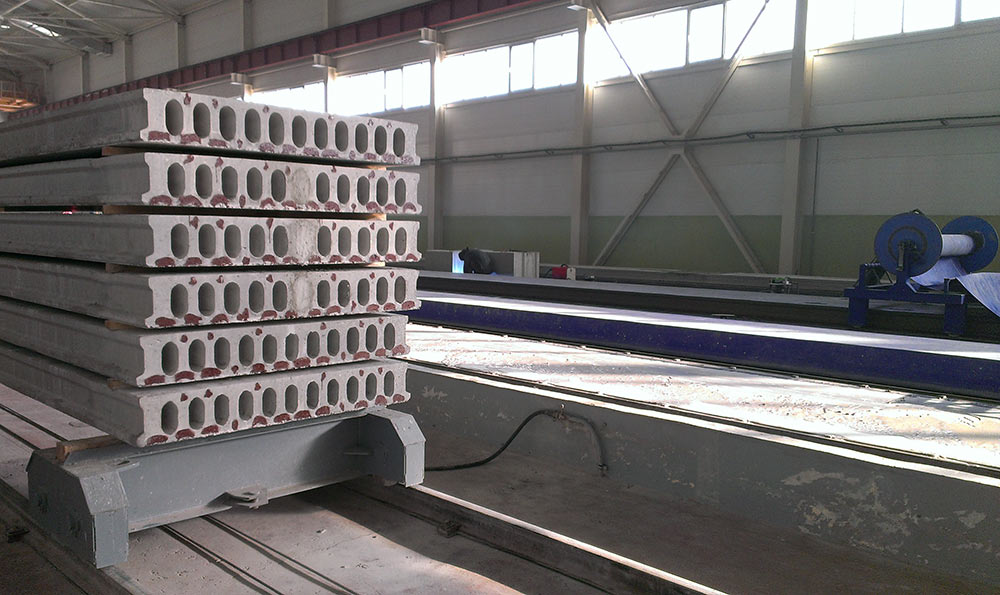
Using this principle, hollow overlay and wall panels, concrete beams, etc. are produced
The Spanish company Tecnospan designs, manufactures and installs lines for the production of concrete products according to this technology. First of all, the floor is made in the production premises by installing the rail lines, which will later be used for forming, cleaning, cutting, transporting and other lines of the products. The number and length of such rail lines depends on the production capacity you will need. The optimal length of one line is 100-120m, you need at least 2 such lines parallel to each other. This is a one-time installation of the production line, after which the production of prestressed concrete can be started.
Production cycle:
- Cable tensioning - at the beginning of the line, cables are fixed across the entire line. The diameter and quantity of cables in the line depends on the product you want to make. A cable tensioning machine is then placed on the rails, which runs along the rails, coils the cable and stretches it. After pulling the cable along the entire line, it is tensioned and anchored there. We have tension cables all along the line. This car is then moved off the tracks and placed on other empty tracks.
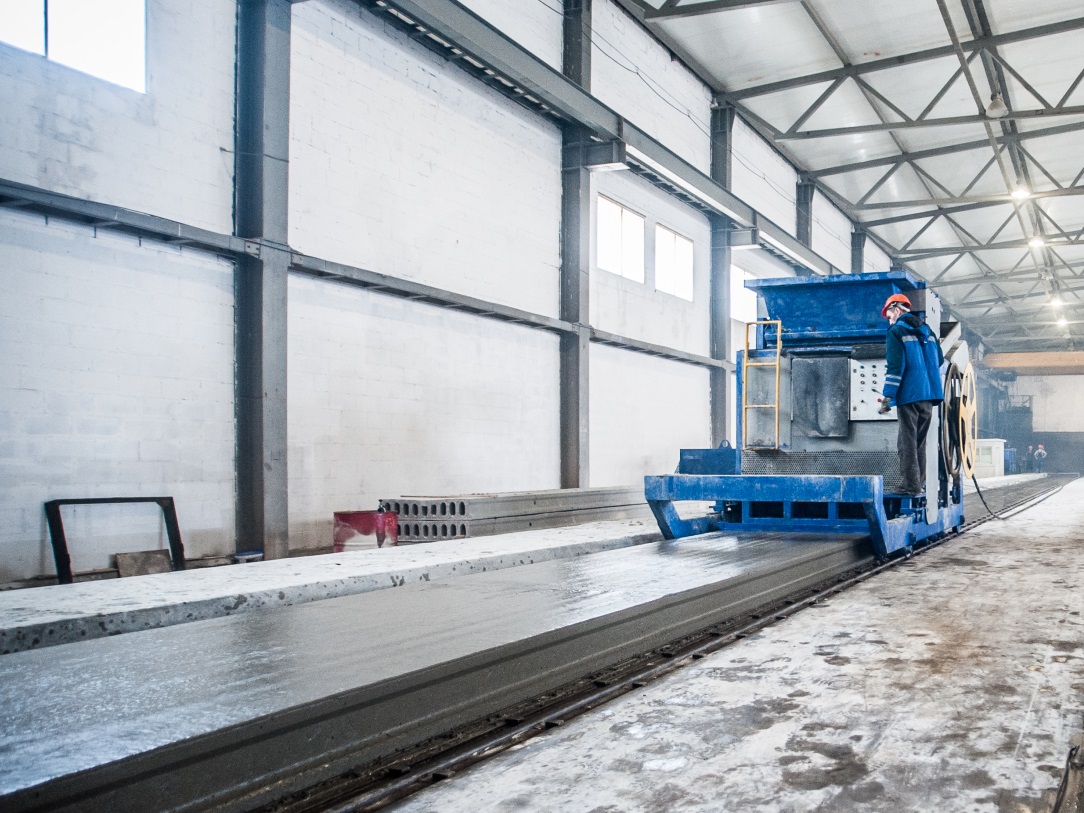
- Product forming - a forming machine is placed on rails with tensioned cables. The required amount of concrete is added to it through the funnel at the top. The machine moves along the rails, pours the concrete between the rails, vibrates it and forms the product (this machine has built-in interchangeable product molds to make different products). This is how the concrete product is formed along the entire length of the rails. At the end of the rails or after forming the corresponding desired quantity, the forming machine is removed from the rails and placed on other empty rails.
- Forming work is complete.
- The next day, there is a hole drilling machine on those rails with the product (if you need to drill holes). After drilling the holes, the machine is removed and placed on other empty rails.
- A cleaning and washing machine is placed on rails, which passes through the entire product and washes and cleans it. The machine is removed and placed on other empty rails.
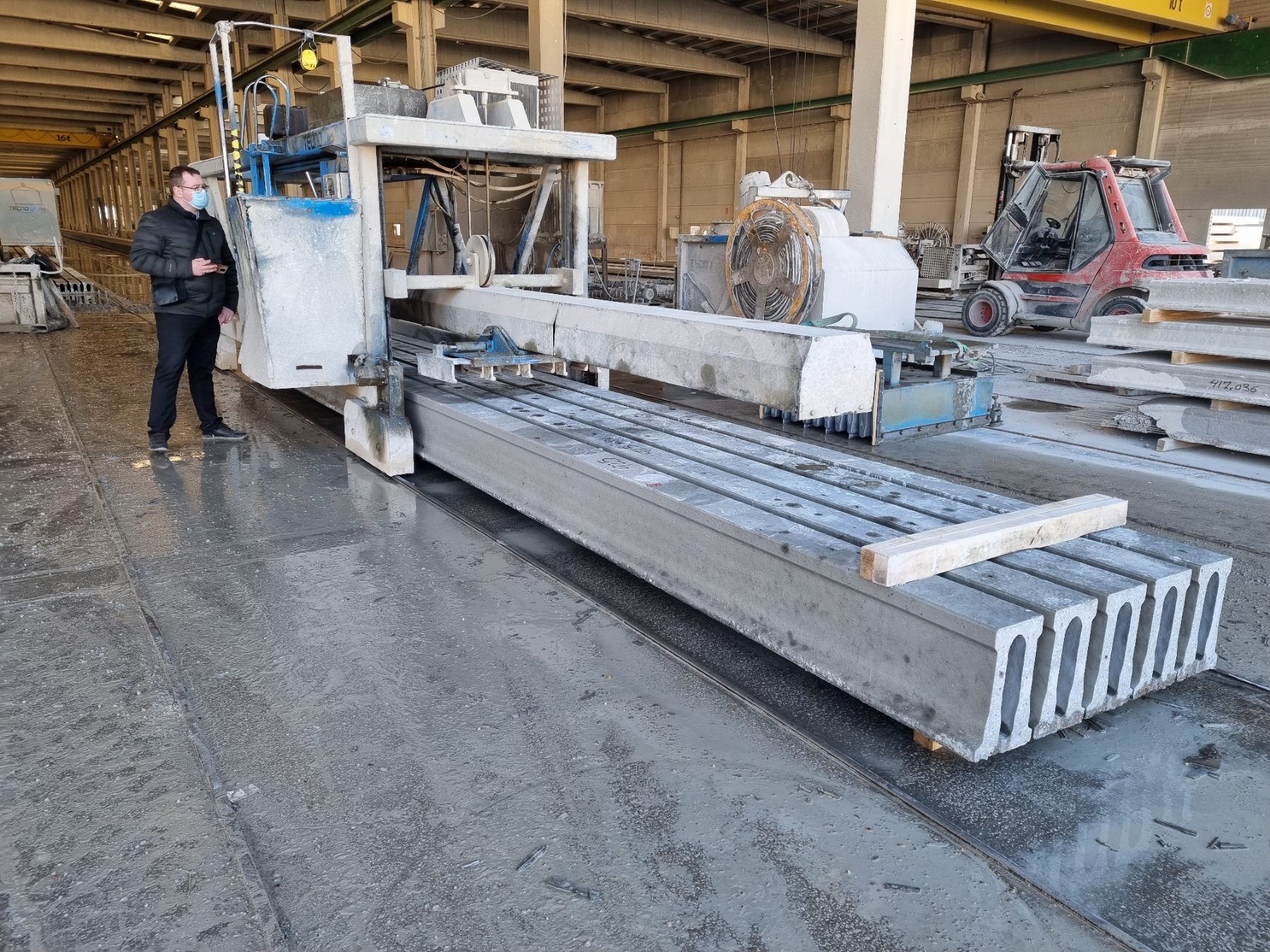
- A cutting machine is placed on the rails, which runs along the rails and stops to cut the concrete product to the required lengths and, if necessary, at the required angle. Lengths can be set using the on-board computer. After cutting the product, the cutting machine is moved and placed on empty rails.
- If necessary, a marking machine is placed on the rails. It runs along the rails and marks each cut piece (writes the date and time of manufacture, lot number, etc.). After everything is assembled, the machine is removed and placed on other empty rails.
- Then the transport machine is placed on the rails. She walks up to each cut product, picks it up by the sides and takes it to the end of the line. There, with a forklift, the product is taken to the storage area. After transporting all the products, the machine is removed from the rails and placed on other free rails.
- The empty line is cleaned of debris and prepared for further work - cable stretching and production of a new batch of products.
Machines on rails and off rails are movable and transported from one place to another with the help of a hoist installed on the top of the production building.
Profile sliding machines are a financially profitable choice due to their high productivity (up to 3 m/min), simple operation (one operator), low energy consumption and economical maintenance costs.
The profile height of manufactured products can be up to 500mm.
Manufacturer: Tecnospan (Spain)
Files to download:






Tel./viber/whatsapp: +370 614 16 991
Props
Kertupio St. 34, 54486 Neveronys, Kaunas districtCompany code: 302670550 gediminas@skodas.lt


